

Most brokers pick a lane. A forex specialist gets very good at forex. A crypto exchange gets very good at crypto. AFG-Management does neither, choosing instead to run several asset classes side by side from one account. This AFG-Management review looks at that choice directly: what breadth like this actually buys a trader, and where it tends to cost something in return.
The Case for Breadth
The obvious upside is convenience. A trader watching a currency pair and a commodity at the same time does not need two logins, two balances, or two support queues to act on both. AFG-Management structures its offering around four core categories, forex, crypto, indices and commodities, each reachable from the same account rather than bolted on as an afterthought.
That matters most for traders whose ideas cross markets. Someone trading a currency pair because of a commodity story, or watching an index alongside a related crypto asset, benefits from watching both inside one execution environment, with no separate account to reconcile against it. The convenience is real, not just a marketing line.
Where Breadth Usually Costs Something
The trade-off is depth. A broker spreading its resources across four asset classes typically cannot match a single-market specialist on the finer points, the deepest order book, the widest range of exotic pairs, the most advanced charting for one specific asset type. This AFG-Management review did not find that kind of specialist-grade depth, and it would be surprising if it had.
What matters is whether the trade-off is honestly presented or oversold. AFG-Management’s own materials describe the range plainly, without claiming best-in-class depth on any single market. That is the right way to sell breadth, as a convenience rather than a superlative.
Accounts and What They Actually Explain
There are several account tiers, ranging from a beginner-friendly option up to one built for experienced traders. The documentation explaining exactly what separates one tier from the next is thinner than it should be, which is worth knowing early, not once funds are already committed. A trader who wants specifics should confirm them directly, since assuming parity with what other multi-asset brokers offer at similar tiers is a guess, not a fact.
AFG-Management’s own FAQ page is more useful than the tier documentation, covering order types, pricing terms and position mechanics without burying any of it in jargon. It is the kind of resource that helps a newer trader understand what they are looking at, which matters more on a multi-asset platform than a single-market one, since there is simply more to learn at once.
Security and Support
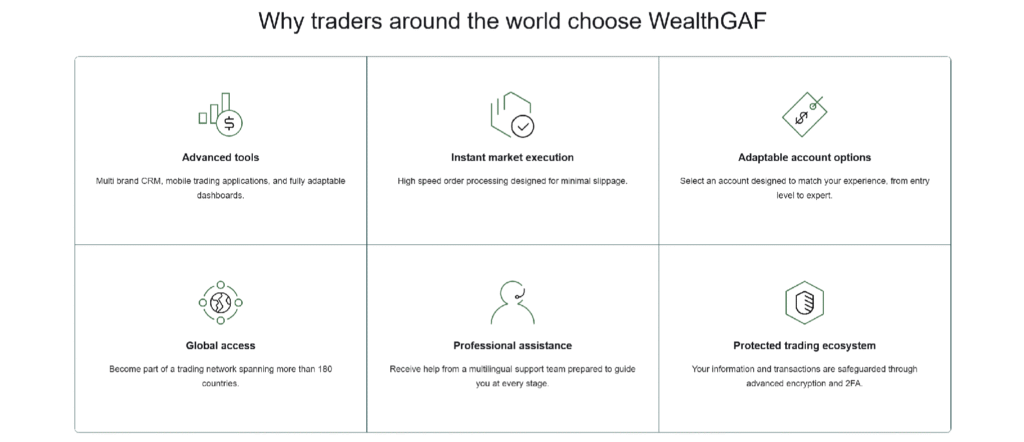
On security, the baseline is what most brokers now offer: encrypted transfers and a two-step login check, both worth switching on from day one no matter which platform a trader ends up choosing. Support is reachable in multiple languages, serving a base spread across many countries, though response quality is worth testing directly. Nobody reading a review, this one included, has actually experienced it firsthand.
Two other sources worth reading alongside this one: this AFG-Management review on ReviewCharts, and a separate assessment that covers different ground entirely.
The Honest Verdict
Not specializing is a real trade-off, not a flaw to be argued away. AFG-Management gains genuine convenience for traders working across markets, and loses the specialist depth a single-focus broker could offer any one of them.
Whether that trade works in a trader’s favour depends entirely on how they actually trade. Someone who lives in one market most days may find less here than someone who moves between several. This AFG-Management review comes down in favour of the platform for the second type of trader and stays neutral on the first, which is the honest answer rather than the convenient one.