

Non-custodial is an easy label to print and a harder one to live up to. A wallet can claim that the keys are yours while still routing you through steps that quietly say otherwise. This Crypto Escrow review treats the claim as something to test rather than accept, and checks whether what the platform promises matches what it actually does. Crypto Escrow bills itself as non-custodial, so that is the bar it gets measured against here.
Setup and First Impressions
The first test of a non-custodial wallet is simple: does it ever take your keys? Here it does not. On setup the wallet generates the keys on your own device and hands you a recovery phrase, 12 or 24 words, to record yourself. There is no identity queue to clear before you reach a working wallet, and nothing sensitive is filed on a company server along the way.
The interface that follows is plainer than most. Your balance sits on the opening screen with a control to conceal it, a price ticker sits across the top, and a search under “My Assets” appears once you hold more than a handful of coins. It reads as a wallet, not a dashboard trying to be ten things.
The Security Model, Checked
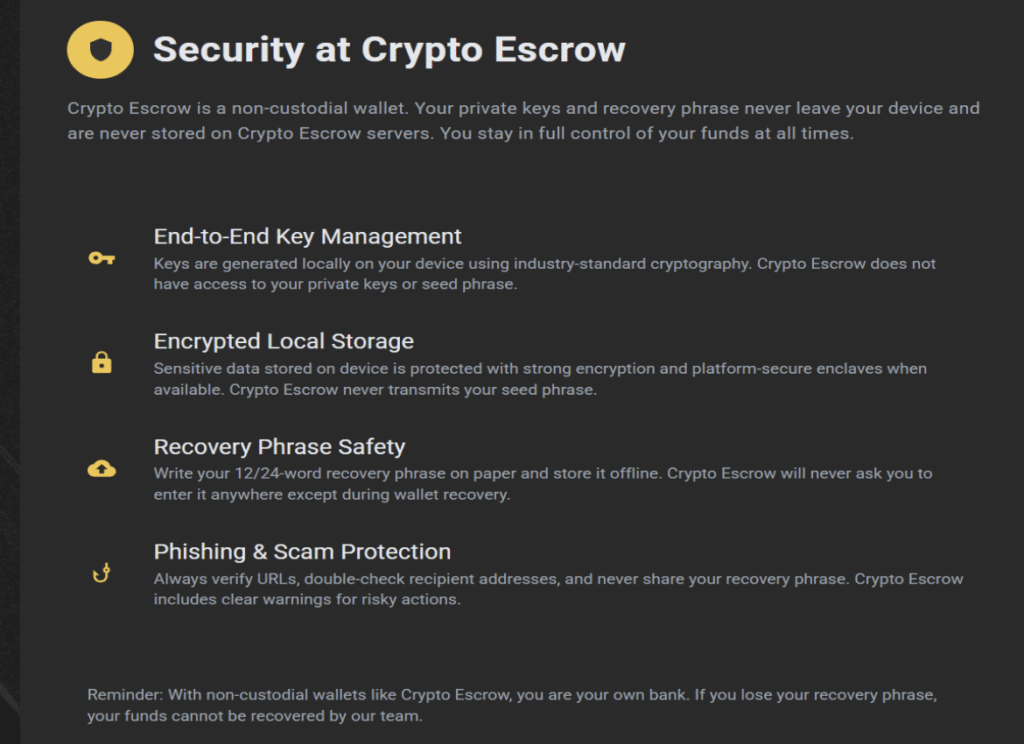
The claim that matters most is where the keys and the recovery phrase live. Crypto Escrow’s position, set out on its security pages, is that both are created and kept on the user’s device and never held by the company. Nothing in normal use contradicts that.
Two smaller touches back it up. The wallet asks you to confirm the destination address one more time before a transfer commits, and it states that it will never request your keys or phrase by email or chat. Both are aimed squarely at how most losses actually happen.
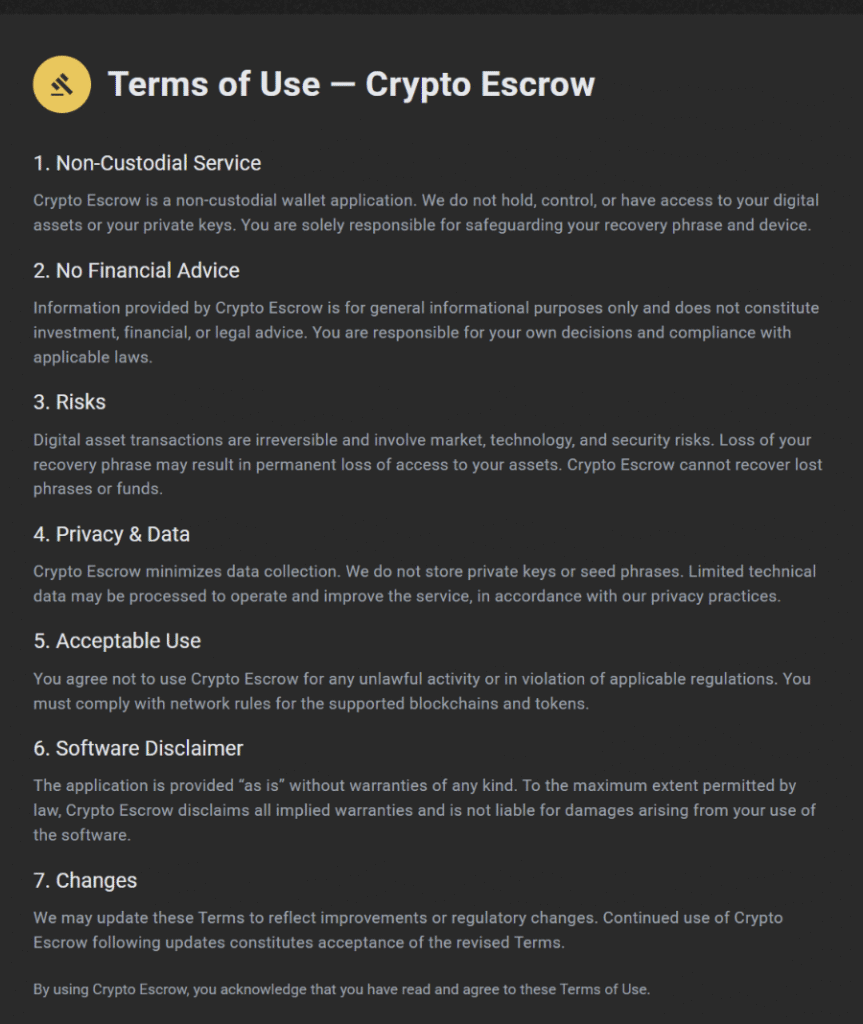
The honest consequence sits on the same page. Because the company holds nothing, it can restore nothing. A lost recovery phrase is not recoverable by anyone, and the platform does not pretend otherwise.
Day-to-Day Use
In routine use, which is where this Crypto Escrow review spent most of its attention, the wallet stays out of its own way. Sending means choosing the wallet, pasting the address, entering an amount and confirming, with that second address check along the way. Receiving shows an address or a QR code to share.
Transfers run on-chain and the history is ordered clearly enough to find an old one later. None of this is novel, which is the point; the parts people use most are the parts that work without thinking.
Support is the one area where expectations need setting. Help comes through written documentation rather than agents on call, an arrangement that rewards confident users and leaves newcomers to do more of the reading themselves.
The Trade-Off and the Verdict
Tested against its own claim, Crypto Escrow passes. It is genuinely non-custodial, it is honest about the responsibility that comes with that, and it declines to blur either point by bolting on trading desks and token feeds it was never meant to carry. A separate Crypto Escrow review on ReviewCharts reaches much the same conclusion, for anyone who wants a second read before trusting the verdict.
The cost of the design is real and worth repeating plainly: lose the phrase and nothing brings it back, and there is no concierge for the day something confuses you. Priced against keys that no company can freeze or misplace, that is a trade a lot of holders will take, and a few will not. If you would rather hear it from people already running the wallet, Trustfeed is where their impressions collect.