

A wallet address does not say which network it belongs to. A Bitcoin address, a Tron address and an Ethereum-style address look different only to people who know what to look for, and many crypto users, especially those who only ever copy an address from a payment request or a message, do not. That makes the first question about any tracing tool a plain one: does it read the chain this address sits on?
FinTracer is a blockchain tracing platform that follows wallets and transactions and draws the result as an interactive map. This FinTracer review covers the chains the site names, how the map and risk levels work, and what getting started involves.
The networks the site names
The FinTracer homepage shows a small graphic labelled blockchains list, naming Ethereum, Bitcoin, Tron and Solana. Because it is an illustration instead of a coverage page, it tells a reader which networks are named and leaves the rest open.
Matching an address to a network takes a few seconds. Bitcoin addresses begin with 1, 3 or bc1, and Tron addresses begin with a capital T. An address starting with 0x belongs to Ethereum or to any of the many other networks that share its format, so the address alone settles little. Solana addresses carry no fixed prefix.
When a tool does not read a network, an empty result says nothing about the wallet.
What the map shows
According to the site, FinTracer traces wallets and visualises transaction flows with interactive network maps, in which wallets are points and transfers are the lines between them. In the homepage sample, wallets are colour-coded, each transfer carries its amount, and a note on one point shows who added it and when, which suggests that a trail can be annotated by the person working through it as well as viewed.
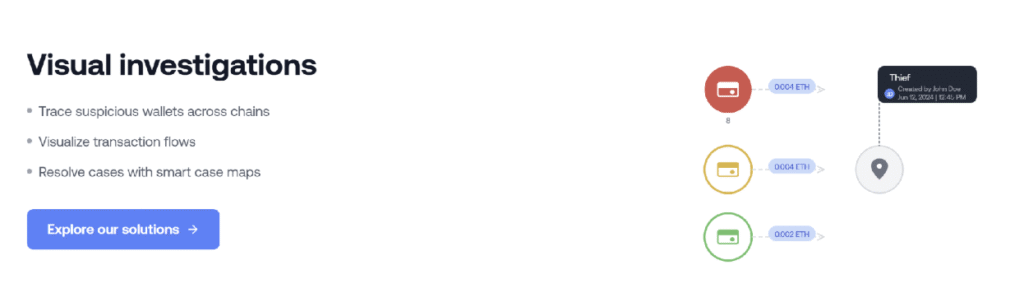
The site lists tracing suspicious wallets across chains and mentions smart case maps for resolving cases. That is where the chain list matters.
Alerts and sanctions exposure
On the monitoring side, the site describes instant alerts on suspicious activity and live transaction tracking. Three levels appear: severe, high and medium. Each sits beside a short reason, for example interaction with payment or the input address blacklist. Entity risk analysis also lists exposure to sanctions among its checks, which is relevant to anyone sending funds to an unfamiliar counterparty.
Access and support
Access starts at the Trace your wallet button, which opens a registration form asking for a name, phone number, country, email address and password. FinTracer analyses activity and does not hold funds, and the form has no payment or deposit field. Support details in the footer include an email address and a phone number, and the site says support is available 24/7.
The verdict
In this FinTracer review, the site backs up an interactive map, risk levels with stated reasons, real-time alerts and a sanctions exposure check, all reached after a short registration that asks for basic details and no payment. What it leaves open is the full list of networks, which the homepage shows as four named chains with no coverage page behind them.
Holders of an address on Ethereum, Bitcoin, Tron or Solana have a clear match, and anyone on another network can put one question to the platform before the first trace.
ReviewCharts carries a FinTracer review with ratings and comments from other users, and AltCoinMarketer’s Fintracer Review: A Smarter Approach To Digital Asset Monitoring looks at the platform from the monitoring side. For a first trace the order is short: confirm the network, enter the address, read the map.


